http://www.farminabox.co.za/
If you live in Barberton, Nelspruit or White River, Mpumalanga RSA, you can share in the goodness of my organically grown produce and authentic farmhouse fare by clicking on the link above and placing your order there...
1 January 2016

16 January 2015
The real initiation of the pond
Finally after the little girls had had their swim, it was the turn of the ducks and the geese to be introduced to their pond. They took to it like ... well, need I say it?
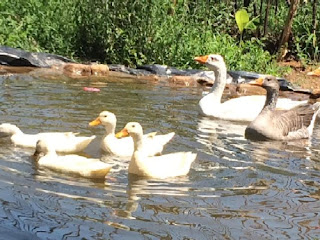


Enter Iliah - prepare to be amused, she wants to catch a duck!

Iliah in hot pursuit

They about face and so does she

And again... darn ducks!
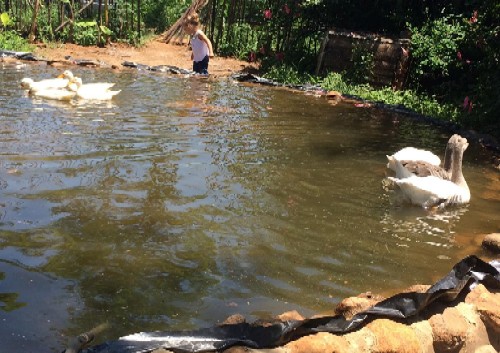
When she decides to go in the geese go on the offensive and I have to run to the rescue!

Just another terrible day at the office for me :)
13 January 2015
You may surmise this story is not about ducks and geese

Wrong. The story is not about the turkeys and the chickens, it is about the abandoned dam floor they are standing on. I always had designs on that old floor and when someone gave me some ducks and geese, I knew exactly what the floor was going to be - a pond!

We built the sides up with natural rock, with a pipe and tap inserted on floor level one side for emptying it out when dirty, then we lined it with plastic and built another layer of 'wall' with natural rock before cutting away the excess plastic, and voila! A pond!

Of course the granddaughters had to do the tour of inspection first... Notice how the clothes get less as the story unfolds...
Discovering clouds of tadpoles

 |
| Khairein decides she is having NONE of that! |
 |
| So much fun and wonderment! The ducks and geese had to wait until the next day. |
22 September 2014
Keeping bees in Mpumalanga SA
So. Keeping bees in Mpumalanga SA is fraught with issues we didn't know of before we started.
First we had a few hives inside our rather extensive yard but when the grandchildren started coming along we decided to move them to other areas on the farm. Fortunately we had spotted some badgers before we did the move, so we knew we were going to have to make it badger friendly. What we didn't know was badgers was going to prove to be the least of our problems.
Here FJ is clearing land for establishing the hives. As soon as he started the loader each morning he was joined by two fork-tailed drongos that flitted and chirped impatiently for him to start churning up the soil so that they could go after prey on the ground or on the wing. I was on the loader with him when the project was nearing completion one day and heard him telling them to wait, he was going to get to their favourite spot soon ...
I asked whether it was customary for him to have conversations with the birds and he frowned and said "Yes of course. When that's all you've got for hours on end..." as if it made perfect sense to him...


First we had a few hives inside our rather extensive yard but when the grandchildren started coming along we decided to move them to other areas on the farm. Fortunately we had spotted some badgers before we did the move, so we knew we were going to have to make it badger friendly. What we didn't know was badgers was going to prove to be the least of our problems.
Here FJ is clearing land for establishing the hives. As soon as he started the loader each morning he was joined by two fork-tailed drongos that flitted and chirped impatiently for him to start churning up the soil so that they could go after prey on the ground or on the wing. I was on the loader with him when the project was nearing completion one day and heard him telling them to wait, he was going to get to their favourite spot soon ...
I asked whether it was customary for him to have conversations with the birds and he frowned and said "Yes of course. When that's all you've got for hours on end..." as if it made perfect sense to him...

When the land had been levelled we planted single poles to make it difficult for the badgers to reach, for fixing the hives to.

Someone we knew who used to do beekeeping with his sons was giving it up because the sons were going to university, so we bought all of his used hives and equipment, and set up our wonderful new apiary.
We planted flowering trees and plants and within weeks the first hives were populated. Unfortunately there is a real unemployment problem among people living in the area and no sooner was there honey, than the trouble started. We never considered the fact that people would brave African (killer) bees without the necessary smoker and protective wear, but they do. And we have never harvested a gram of our own honey from this apiary.
What is needed is a tall pole with a solar panel and alarm system, and a fence to keep animals out, so that when people move into the area we will be alerted by the alarm to take action... Sigh. We love our country but it is hard to have to consider security before one can do anything whatsoever always.

3 February 2014
Animal, vegetable, miracle
is the most inspirational book I have read in a long time. Author Barbara Kingsolver has been a favourite since I first read The Poisonwood Bible yonks ago, but who knew? She is also a consumer with a conscience! I almost feel as if she should be classed as a non-consumer, having read how they as a family pledged utter self-sustainability for the period of a full year, and the delightful results of said pledge.
After six months of non-blogging I have been driven to my computer to continue blogging, if that will make a difference to anyone's life who may come across the articles and read them (all the future ones I now have in mind especially!)
I am sure that having come that far, living off the land and by one's own means for a full calendar year, it becomes second nature not to look to supermarket shelves for sustenance anymore, because whatever you are looking at has been grown from hybridised or GM seed, so that it will outlast transportation and the inordinate time spent in packing sheds being washed and handled, and on supermarket shelves, with little regard for taste. And then it has either been processed, transformed into something different and sometimes unrecognisable (try chocolate coated olives!) transported 100,000 miles, radiated or otherwise preserved, with even less regard for nutritional value than taste. Having tasted one's own produce, grown from honest seed which is true to how that food looked and tasted 100 years back, and having experienced the energy boost from ingesting such food, and the obvious health benefits, there is no going back.
What am I saying? I am now more than ever convinced it is the right thing to source and grow heirloom type vegetables, I am looking forward to this year of change, and of growing the old so that it seems brand new...
After six months of non-blogging I have been driven to my computer to continue blogging, if that will make a difference to anyone's life who may come across the articles and read them (all the future ones I now have in mind especially!)
I am sure that having come that far, living off the land and by one's own means for a full calendar year, it becomes second nature not to look to supermarket shelves for sustenance anymore, because whatever you are looking at has been grown from hybridised or GM seed, so that it will outlast transportation and the inordinate time spent in packing sheds being washed and handled, and on supermarket shelves, with little regard for taste. And then it has either been processed, transformed into something different and sometimes unrecognisable (try chocolate coated olives!) transported 100,000 miles, radiated or otherwise preserved, with even less regard for nutritional value than taste. Having tasted one's own produce, grown from honest seed which is true to how that food looked and tasted 100 years back, and having experienced the energy boost from ingesting such food, and the obvious health benefits, there is no going back.
What am I saying? I am now more than ever convinced it is the right thing to source and grow heirloom type vegetables, I am looking forward to this year of change, and of growing the old so that it seems brand new...
4 July 2013
We breed owls. Barn owls. Not really, no...
But it feels as if we do. When we first moved here we realised there was a nest in the roof over the verandah, which has a knotty-pine ceiling. Some planks had rotted and fallen out near the gutter and that was where they gained access.
We hate rats and love owls, so the arrangement suits us well.
Then they moved away and weren't seen again for a few years and we thought we had somehow offended them, but not so. Possibly one of the pair was killed or perhaps the owls that subsequently moved in were from a later generation, I don't know. What I do know is that we haven't been without owls for most of the past five years, and a new clutch of four to five fledglings leave that nest every six to nine months on average. That's a lot of owls. We must be keeping the valley and surrounding mountains well stocked.
 It is totally delightful when the young ones fledge, because they emerge not knowing where to go, what to do, or what they are looking at. Sometimes they gently drift down to the ground like a falling leaf. Seen here, they often alight on a window sill, and then take on threatening stances when approached from the inside.
This one started swaying from side to side, as if to say "bring it on..."

We spend a lot of time on the verandah or at the fireplace outside in the evenings, when we are privy to the antics of the new fledglings. What makes it especially delightful is that the barn owl mom starts incubating the eggs as soon as she had lain the first one, although she may lay another four or five eggs over the two weeks following. As soon as the first one has hatched there is increased activity as the parents take turns all night long hunting and bringing in rats for the growing family to devour. They hatch one after the other, with a few days in between. As long as the food keeps coming all the chicks grow up in perfect harmony with one another. The result is that we have a new fledgling emerging from the roof every few days for up to two weeks at a time, giving us a lot of viewing pleasure.
Because he smokes Jamie sits on the verandah in the evenings watching series on his laptop or engaging in other activities which he can do outside. Because of this habit he has had the pleasure of getting up close and personal with the young owls on many an occasion. One evening one alighted on the sofa next to him and turned its little swivel head to take a good look, quizzically swaying its head from side to side as owls do. Jamie involuntarily started to chuckle, which made the little head move from side much quicker and the more Jamie chuckled the quicker the movements became and then the owlet decided it was possibly best to leave.
 The other evening he had the closest encounter yet when sitting with his feet crossed on the coffee table. The young owl dropped from the roof, spread its wings and gently flew towards him alighting on his toe. Fortunately it is winter and he was wearing closed shoes because those talons are like razor blades! (Spoken like one who has had the misfortune of close contact once). Before he could swing his cellphone/camera into action though it sort of lost its grip and flapped a few meters away to the chairs (upended at night to discourage the dogs).

... when life exists not so much in breathing but in those moments that take your breath away ...
We hate rats and love owls, so the arrangement suits us well.
Then they moved away and weren't seen again for a few years and we thought we had somehow offended them, but not so. Possibly one of the pair was killed or perhaps the owls that subsequently moved in were from a later generation, I don't know. What I do know is that we haven't been without owls for most of the past five years, and a new clutch of four to five fledglings leave that nest every six to nine months on average. That's a lot of owls. We must be keeping the valley and surrounding mountains well stocked.
 It is totally delightful when the young ones fledge, because they emerge not knowing where to go, what to do, or what they are looking at. Sometimes they gently drift down to the ground like a falling leaf. Seen here, they often alight on a window sill, and then take on threatening stances when approached from the inside.
This one started swaying from side to side, as if to say "bring it on..."

We spend a lot of time on the verandah or at the fireplace outside in the evenings, when we are privy to the antics of the new fledglings. What makes it especially delightful is that the barn owl mom starts incubating the eggs as soon as she had lain the first one, although she may lay another four or five eggs over the two weeks following. As soon as the first one has hatched there is increased activity as the parents take turns all night long hunting and bringing in rats for the growing family to devour. They hatch one after the other, with a few days in between. As long as the food keeps coming all the chicks grow up in perfect harmony with one another. The result is that we have a new fledgling emerging from the roof every few days for up to two weeks at a time, giving us a lot of viewing pleasure.
Because he smokes Jamie sits on the verandah in the evenings watching series on his laptop or engaging in other activities which he can do outside. Because of this habit he has had the pleasure of getting up close and personal with the young owls on many an occasion. One evening one alighted on the sofa next to him and turned its little swivel head to take a good look, quizzically swaying its head from side to side as owls do. Jamie involuntarily started to chuckle, which made the little head move from side much quicker and the more Jamie chuckled the quicker the movements became and then the owlet decided it was possibly best to leave.
 The other evening he had the closest encounter yet when sitting with his feet crossed on the coffee table. The young owl dropped from the roof, spread its wings and gently flew towards him alighting on his toe. Fortunately it is winter and he was wearing closed shoes because those talons are like razor blades! (Spoken like one who has had the misfortune of close contact once). Before he could swing his cellphone/camera into action though it sort of lost its grip and flapped a few meters away to the chairs (upended at night to discourage the dogs).
... when life exists not so much in breathing but in those moments that take your breath away ...
2 July 2013
What I have learned about keeping rabbits you won't find in a book or on the internet.
What I found on the internet was a very informative and happy account of how wonderful it is to keep rabbits, how they produce 6 x the kilo's in a 2m2 hutch than cows on 1 acre of land, how much easier and relatively cheaper it is to produce this meat, and how they don't smell... The latter fact was where it all fell down from the get-go.
Kept in welded steel cages (read batteries) such as one is 'supposed to do' to keep it 'practical' and 'commercially viable', they stink. There is not a suitable euphemism for the phenomenon. We cleaned the trays, we fed and watered them, we fed them green stuff and not just pellets. They stank. And the little ones died like flies. I'm sure there are 'factories' which is what the article called them which work well. Huge structures where the rabbits never see sunshine or feel the wind blow, that are super-controlled and not to make the author out to be a liar, perhaps they don't smell. Perhaps they have systems in place because the business is big enough, to ensure total cleanliness, no smell and perfect record-keeping which I believe is necessary and where I fell down because I simply don't have all day to stand and watch when a buck has been brought to a doe to know when exactly "it" happened with the result I probably left them together too long just to be sure. Also being semi out of doors there were other factors, eg rats running over the cages at night freaking out the rabbits.
Perhaps I didn't have the ultimate perfect cages, because the rabbits always sat in their food bowls and defecated there, and for some reason urinated in their water bowls. The ideal would have been to have had those little water spouts where they have to put their mouth over to get the water out, rather than open water, but I just couldn't find them straightaway when I needed them.
I don't know whether they feel happiness or not but those rabbits didn't seem happy to me. Perhaps it was just me being unhappy for caging them so but the point is it was not working and the babies kept dying, most of a litter being dead within three to four days. I decided they had to get out of the cages. So I took them into a facility with a cement floor where they couldn't dig and gave them wooden hutches placed far apart to crawl into that would be nice and dark, cosy for moms with babes. The does were all together in a large room and the buck in a smaller room adjacent. My totally unprofessional method would be to open up between the two rooms for a week or so, and then separate them again until all the does had dropped and weaned their litters, when the young ones would be removed and the process started again.
It seemed to work well, until one morning there was a dead doe on the floor with some fairly large pups lying dead as well. I asked a helper to reach into the hutch and see if there were any live ones left, and all he felt was a snake. A very large snake, none other than a black mamba which proceeded to emerge from the hutch hopping mad and with tell-tale bumps where the rest of the little ones had been swallowed. We killed and measured it, more than 3m in length.
This happened on three different occasions, each snake being between 3 and 4m long, and try as we might we simply could not stop every last hole in that shed, the snakes always found one we had missed. Or they came armed with their own wire cutters and hammer and chisel, I don't know. We lost about 30 rabbits big and small to those mamba, which was substantial given that we only had four buck and about six doe to start with when we moved them there. They were breeding successfully, but the snake issue was a huge one. It was simply too dangerous for us humans, let alone the losses in does and pups we were experiencing.
I drew on the experience I gained as a young mother, keeping rabbits for pets for FJ and his sister when they were little. We dug around the perimeter of the new cage 1m deep and placed concrete blocks close together in the trenches. Each rabbit was going to have at least 2m2 with the trays from the original cages to serve as a roof where they could hide from rain. They were going to be able to dig their burrows and do their ablutions in or on the ground, and make their own nurseries underground such as rabbits do. The difference was the pets were all kept together, and here I was going to separate the rabbits inside their own smaller enclosures. Double gates and bird netting see to it that no rat and no snake gets in there.
 I'm happy to say they have been in this new facility since November and I haven't had to clean it once. It does not smell of anything and yes, even if it is perhaps my imagination, I swear they look happy! Moreover, they are doing what rabbits do best...

 Let the pictures tell the story. These three pics were taken around Christmas...
 And these were taken last week...


I have just finished a new facility along the same lines so this is the last day they will all be together - we don't want to hear complaints about overcrowding now do we?
Kept in welded steel cages (read batteries) such as one is 'supposed to do' to keep it 'practical' and 'commercially viable', they stink. There is not a suitable euphemism for the phenomenon. We cleaned the trays, we fed and watered them, we fed them green stuff and not just pellets. They stank. And the little ones died like flies. I'm sure there are 'factories' which is what the article called them which work well. Huge structures where the rabbits never see sunshine or feel the wind blow, that are super-controlled and not to make the author out to be a liar, perhaps they don't smell. Perhaps they have systems in place because the business is big enough, to ensure total cleanliness, no smell and perfect record-keeping which I believe is necessary and where I fell down because I simply don't have all day to stand and watch when a buck has been brought to a doe to know when exactly "it" happened with the result I probably left them together too long just to be sure. Also being semi out of doors there were other factors, eg rats running over the cages at night freaking out the rabbits.
Perhaps I didn't have the ultimate perfect cages, because the rabbits always sat in their food bowls and defecated there, and for some reason urinated in their water bowls. The ideal would have been to have had those little water spouts where they have to put their mouth over to get the water out, rather than open water, but I just couldn't find them straightaway when I needed them.
I don't know whether they feel happiness or not but those rabbits didn't seem happy to me. Perhaps it was just me being unhappy for caging them so but the point is it was not working and the babies kept dying, most of a litter being dead within three to four days. I decided they had to get out of the cages. So I took them into a facility with a cement floor where they couldn't dig and gave them wooden hutches placed far apart to crawl into that would be nice and dark, cosy for moms with babes. The does were all together in a large room and the buck in a smaller room adjacent. My totally unprofessional method would be to open up between the two rooms for a week or so, and then separate them again until all the does had dropped and weaned their litters, when the young ones would be removed and the process started again.
It seemed to work well, until one morning there was a dead doe on the floor with some fairly large pups lying dead as well. I asked a helper to reach into the hutch and see if there were any live ones left, and all he felt was a snake. A very large snake, none other than a black mamba which proceeded to emerge from the hutch hopping mad and with tell-tale bumps where the rest of the little ones had been swallowed. We killed and measured it, more than 3m in length.
This happened on three different occasions, each snake being between 3 and 4m long, and try as we might we simply could not stop every last hole in that shed, the snakes always found one we had missed. Or they came armed with their own wire cutters and hammer and chisel, I don't know. We lost about 30 rabbits big and small to those mamba, which was substantial given that we only had four buck and about six doe to start with when we moved them there. They were breeding successfully, but the snake issue was a huge one. It was simply too dangerous for us humans, let alone the losses in does and pups we were experiencing.
I drew on the experience I gained as a young mother, keeping rabbits for pets for FJ and his sister when they were little. We dug around the perimeter of the new cage 1m deep and placed concrete blocks close together in the trenches. Each rabbit was going to have at least 2m2 with the trays from the original cages to serve as a roof where they could hide from rain. They were going to be able to dig their burrows and do their ablutions in or on the ground, and make their own nurseries underground such as rabbits do. The difference was the pets were all kept together, and here I was going to separate the rabbits inside their own smaller enclosures. Double gates and bird netting see to it that no rat and no snake gets in there.


I have just finished a new facility along the same lines so this is the last day they will all be together - we don't want to hear complaints about overcrowding now do we?
Subscribe to:
Posts (Atom)